Shared affective expression:
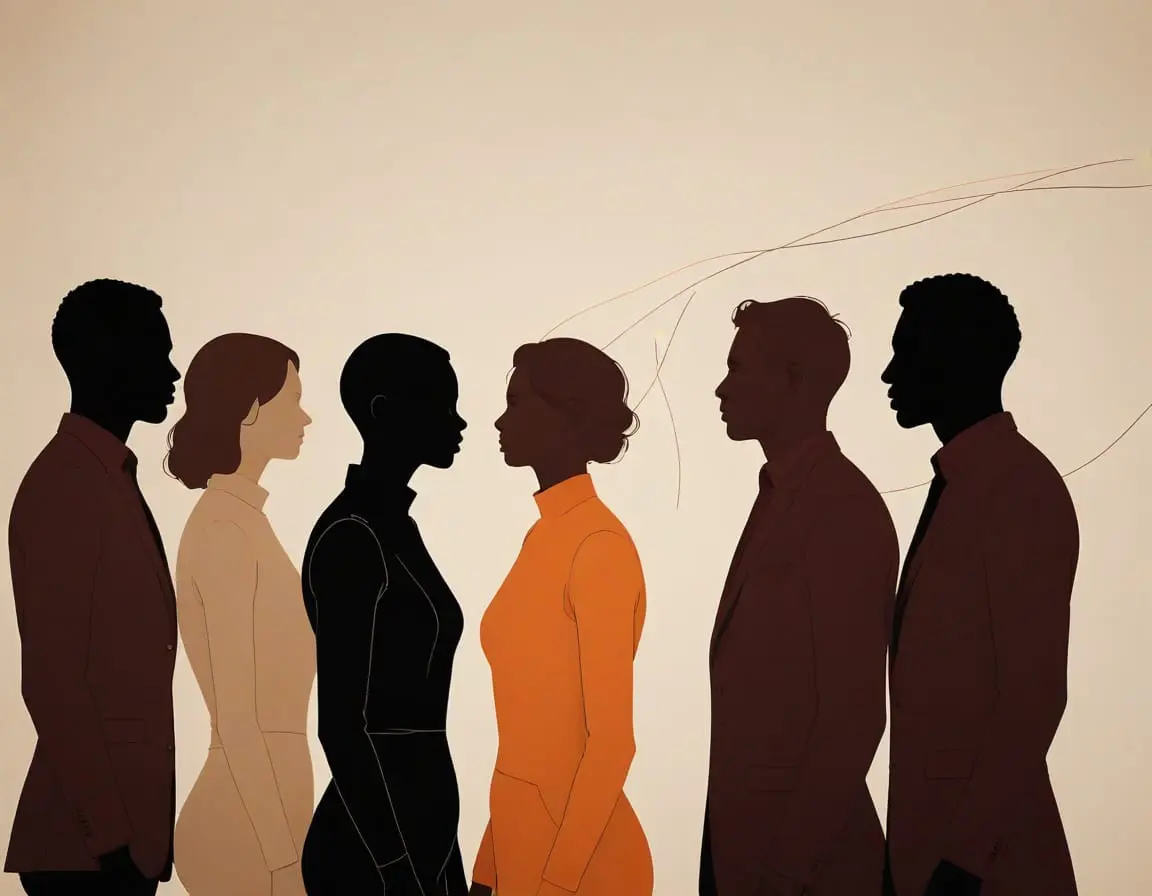
Shared affective expression refers to the manner in which individuals or groups come to feel with one another through interaction, communication, and shared environments. Positioned within affect theory, it examines how emotions and bodily feelings are experienced, expressed, and circulated in social life. Synchronization occurs through speech, tone of voice, facial expressions, gestures, or simply by being in the same charged space, such as a protest, a funeral, or a stadium. Over time, these shared moments shape how communities understand what it means to feel “together” in joy, grief, anger, or hope.
Relational Dynamics and Collective Action
At its core, shared affective expression is relational and dynamic rather than private and fixed. One person’s mood, posture, or micro-expression can trigger shifts in another’s state, creating a feedback loop of emotional resonance that moves through a group. This process remains culturally and socially embedded: distinct communities provide unique emotional vocabularies and expectations, from highly specific feeling-terms to norms about when and how emotions should be displayed. These patterned ways of feeling together help build group identity and cohesion, yet they can also mark insiders and outsiders by signalling who belongs within a particular emotional style.
Shared affect also plays a coordinating role in collective action. Emotions such as frustration, enthusiasm, or concern can align intentions and behaviours, prompting members of a group to modify actions in support of shared goals. Affect, in this way, performs practical work: it organizes attention, smooths cooperation, and helps individuals move in step, whether in a workplace team, a social movement, or a family making a difficult decision. When this coordination becomes durable, it can produce affective communities, in which a sense of belonging rests as much on shared feeling as on shared belief.
Embodiment and Emotional Resonance
Affect theorists emphasize that much of this takes place on a pre-conscious, embodied level, as sensations and tensions circulate before being named as emotions. Shared affective expression is not limited to positive states; it encompasses intense sadness, fear, rage, or collective grief, which can deepen solidarity or intensify conflict depending on context. In intimate relationships and close-knit groups, sharing emotions in this embodied, often wordless manner can deepen connection, mutual understanding, and care, even as it may also amplify strain when difficult feelings reverberate unchecked.
Cultural Influences
Cultural patterns strongly shape how shared affective expression appears in everyday life, because communities differ in values, norms, and communication styles. High-context cultures such as Japan or China rely on implicit messages and non-verbal cues. Emotions are often signaled through subtle gestures, silence, or shifts in posture rather than direct statements. Low-context cultures like the United States or Germany tend to favour explicit, verbal declarations of feeling. In these settings, emotional expression appears more direct and overt in both public and private interactions.
These contrasts intersect with the familiar distinction between individualistic and collectivistic cultures. In individualistic settings such as the United States or Canada, personal emotional expression and self-determination are often encouraged. Showing what one feels is frequently framed as an important form of authenticity. Collectivistic cultures such as China or Korea place more emphasis on group harmony. In these societies, public emotional restraint becomes a way to protect relationships and maintain social balance. This does not mean people feel less; instead, affect is managed differently, especially in shared or formal contexts.
Emotion Concepts and Cultural Meaning
Language adds another layer, providing culture-specific emotion concepts that guide how feelings are recognized and shared. Terms such as Portuguese “saudade” for nostalgic longing, Japanese “mono no aware” for a tender awareness of transience, Danish “hygge” for cozy social comfort, or Zulu “ubuntu” for emotionally saturated interconnectedness, show how emotional life is named and organized in distinct ways. These words do more than label inner states. They invite particular ways of sensing, valuing, and expressing emotion collectively, which may be difficult to translate into other cultural frameworks.
Even basic cues like facial expressions, intensity, and arousal are filtered through cultural lenses. Research suggests that Americans often focus on the mouth when reading emotions, while Japanese observers attend more to the eyes. This leads to different interpretations of the same face. European Americans may display more intense and frequent smiles during positive events than Hmong or Chinese Americans who report similar inner feelings. This reveals a gap between felt emotion and public display norms. Western cultures frequently valorize high-arousal states and emotional openness, reading them as signs of sincerity. Countries such as Japan and Finland often treat emotional restraint and low-arousal calm as markers of maturity and self-control.
Cultural worlds also tie particular emotions to specific events, objects, or practices. What evokes delight in one setting might provoke disgust or indifference in another. Foods, rituals, or family arrangements carry sharply different affective weights across societies, shaping what people collectively celebrate, mourn, or fear. Recognizing these differences in shared affective expression is crucial for cross-cultural encounters. This awareness reduces misinterpretation, supports more attuned communication, and makes space for grounded, respectful relationships in an increasingly interconnected world.
The Role Of Language
Language plays a crucial role in shaping affective expressions, influencing how emotions are experienced, conceptualized, and communicated across cultures. This relationship between language and emotion is multifaceted and deeply intertwined with cognitive processes and cultural contexts. Language provides the framework for conceptualizing and categorizing emotional experiences. The Conceptual Act Theory (CAT) suggests that language is fundamental in constructing emotional experiences and perceptions. Words serve as “glue” that binds together disparate instances of an emotion category, helping individuals make meaning of their bodily sensations and situational contexts.
The Sapir-Whorf Hypothesis, or linguistic relativity, proposes that the structure of a language influences its speakers’ worldview and cognitive processes, including emotional experiences. In one instance, Russians distinguish between light and dark blue, potentially shaping colour perception and associated emotions. German has compound words like “Schadenfreude” and “Weltschmerz,” reflecting a cultural value for nuanced emotional understanding.
The richness of a language’s emotional lexicon can affect the depth and nuance of emotional expression. Languages with more diverse emotional vocabularies may promote more detailed exploration of feelings and richer communication. Some languages include unique words for specific emotional states that lack direct translations elsewhere, such as the Portuguese “saudade” or the Japanese “mono no aware.”
Bilingualism, Emotion Regulation, and Context
Bilingual individuals often experience emotions differently across their languages. Code-switching can allow bilinguals to choose the language that best captures their feelings in a given moment. Children of bilingual parents may develop a broader emotional vocabulary, enhancing their ability to verbalize emotions.
Language plays a role in emotion regulation and processing. Giving words to negative emotions can help regulate emotional states and bring calm. The act of labeling emotions shapes how those feelings are perceived and experienced. Language also shapes emotional expression within cultural contexts. High-context cultures may rely on implicit communication and non-verbal cues, while low-context cultures often encourage direct expression through language.
Language is not merely a tool for communicating emotions but an integral component in shaping how emotions are conceptualized, experienced, and expressed. Understanding this relationship is crucial for effective cross-cultural communication and emotional intelligence.
Recent studies in neuropsychology indicate that linguistic diversity not only extends emotional vocabulary but also affects the bodily experience of emotion itself. When exposed to emotion words, individuals may even show measurable changes in heart rate or skin conductance, suggesting that labels act as “emotional triggers,” priming the mind and body for particular affective states. This interplay between spoken terms and somatic response highlights the embodied nature of language, supporting claims from cognitive science that thinking, feeling, and language are deeply co-constructed.
Digital Language, and Evolving Expression
The digital era is reshaping affective expression through new forms of language. Emojis, memes, and online vernaculars have become essential components of emotional exchange in digital interactions. These tools allow users to supplement, nuance, or entirely replace text-based communication with images or symbols that capture complex feelings in shorthand. As culture and language evolve together, digital emotional expression continues to create new frameworks for how emotions are shared, interpreted, and felt within virtual communities.
Shared affective expression is a multidisciplinary concept that underscores the interconnectedness of human emotions within cultural and social frameworks. Anthropologist, psychologists, sociologist and philosophers, continually draw from it. It is central to understanding how individuals relate to one another and form meaningful bonds in diverse settings.
Article by: Romina Wendell
Published: 03/05/2025
Last Modified: 12/04/2025
This page is a living document and overtime will be revised and updated to reflect evolving knowledge and to improve clarity.
- https://journals.sagepub.com/doi/abs/10.1177/1754073914534479
- https://www.frontiersin.org/articles/10.3389/fpsyg.2015.00444/full
- https://www.sciencedirect.com/science/article/pii/S0388000197000041
- https://www.sciencedirect.com/science/article/pii/S0893608009001506
- https://arxiv.org/abs/1103.2376
- https://ejournal.reysha.org/index.php/jlt/article/view/42
- https://www.frontiersin.org/articles/10.3389/fpsyg.2015.01501/full
- https://www.sciencedirect.com/science/article/pii/S2213422016300191
- https://onlinelibrary.wiley.com/doi/abs/10.1002/9781119519348.ch24
- https://www.tandfonline.com/doi/abs/10.1080/13670050.2020.1730763
- https://psycnet.apa.org/record/2019-13688-001
- https://www.degruyterbrill.com/document/doi/10.1515/text-2016-0036/html
- https://journals.plos.org/plosone/article?id=10.1371/journal.pone.0221297
- https://hnpublisher.com/ojs/index.php/OMS/article/view/704
- https://www.frontiersin.org/articles/10.3389/fpsyg.2021.645173/full